Introduction to Industrial Helical Coil Springs
Helical coil springs are fundamental components in mechanical engineering, designed to absorb, store, and release energy under loads. Manufactured from high-tensile spring steel, these helical structures are critical in machinery, automotive suspensions, and industrial assemblies. Understanding their mechanical dynamics is essential for engineering reliable, high-fatigue-life components.
What Are Helical Coil Springs?
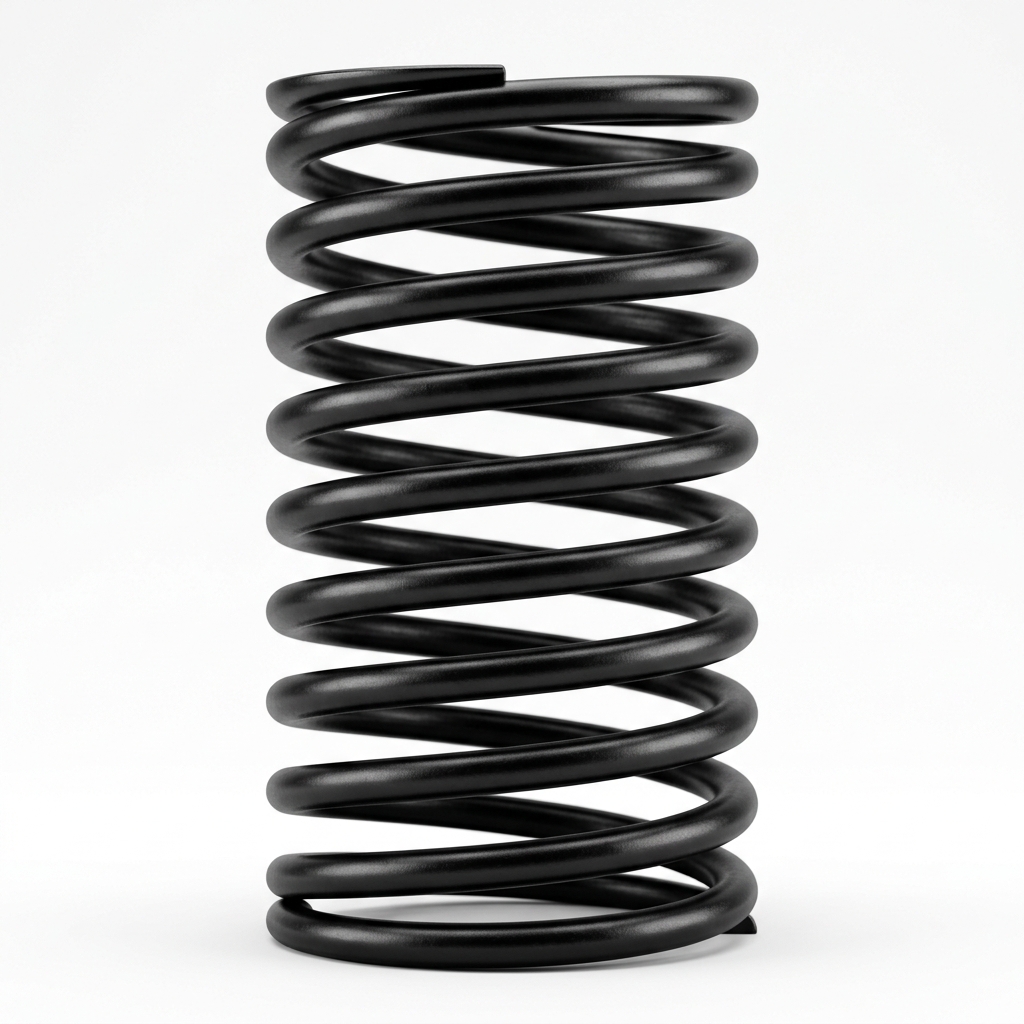
Helical coil springs are wire coils wound in a cylindrical profile. When subjected to force, the wire undergoes torsional stress. This geometry allows the spring to compress, extend, or rotate, returning to its original shape once the force is removed, storing mechanical energy in the process.
Helical Compression vs Extension & Torsion Dynamics
Helical springs are designed for specific force directions:
- Compression Springs: Wound with pitch spacing to allow wire compression. They resist push forces.
- Tension / Extension Springs: Wound tightly with hooks or loops at each end to resist pull forces.
- Torsion Springs: Resists rotational torque or angular forces.
Spring Rate Calculation & Torsional Stress Formulas
The stiffness of a coil spring is defined by its Spring Rate (k), calculated as:
Where:
- k: Spring Rate (Stiffness in N/mm)
- G: Shear modulus of the wire material
- d: Wire diameter
- D: Mean coil diameter
- n: Number of active coils
Fewer active coils and thicker wire lead to significantly stiffer spring rates.
High Carbon & Alloy Spring Steel Material Selection
Selecting the right spring material is critical for load and fatigue life:
- High Carbon Spring Steel: Cold-drawn patented wire (Grade 1, 2, or 3) for standard cycles.
- Chrome-Silicon / Chrome-Vanadium: Alloy steels suitable for high stress and high dynamic fatigue life (e.g. engine valves).
- Stainless Steel (302, 316): Offers high corrosion resistance for wet or chemical environments.
| Parameter | Specification Details |
|---|---|
| Material | High Carbon Spring Steel (IS 4454), Chrome Silicon (55CrSi), SS302/316 |
| Wire Diameter | 0.2 mm to 12.0 mm |
| Finish Options | Zinc Plating, Black Oxide, Powder Coating, Electro-polishing |
| Spring Configurations | Helical Compression, Helical Extension, Helical Torsion |
| Standards | Conforms to IS 4454, DIN 2088 (Torsion), DIN 2095, DIN 2098 (Compression) |
| Applications | Automotive Valvetrain, Enclosure Latches, Machined Actuators, Industrial Machinery |
Key Engineering Advantages of Coil Springs
Installing custom coil springs provides clear B2B engineering benefits:
- Constant Force Profiles: Provides linear force curves under standard deflections.
- Dynamic Shock Absorption: Smoothly dampens mechanical impacts.
- Cost-Effective Fatigue Life: High availability of wire sizes and economical production paths.
Industrial Machinery & Automotive Valvetrain Applications
Helical springs are universal components, operating inside switchgears, automotive clutches, and production assembly machinery.
Shot Peening & Fatigue Life Maintenance
To maximize service life:
- Avoid cyclic stress beyond the fatigue limit of the material to prevent stress cracks.
- Ensure springs are shot-peened to introduce compressive residual stress on the wire surface, dramatically boosting cycle life.
- Monitor for corrosion pits, which act as stress concentrators leading to sudden mechanical fatigue breaks.
Engineering Conclusion & Summary
Spring steel coil springs are standard mechanical elements. By tuning the wire diameter, mean diameter, and active coil count, engineers can specify the exact spring rate required for robust machinery operation.